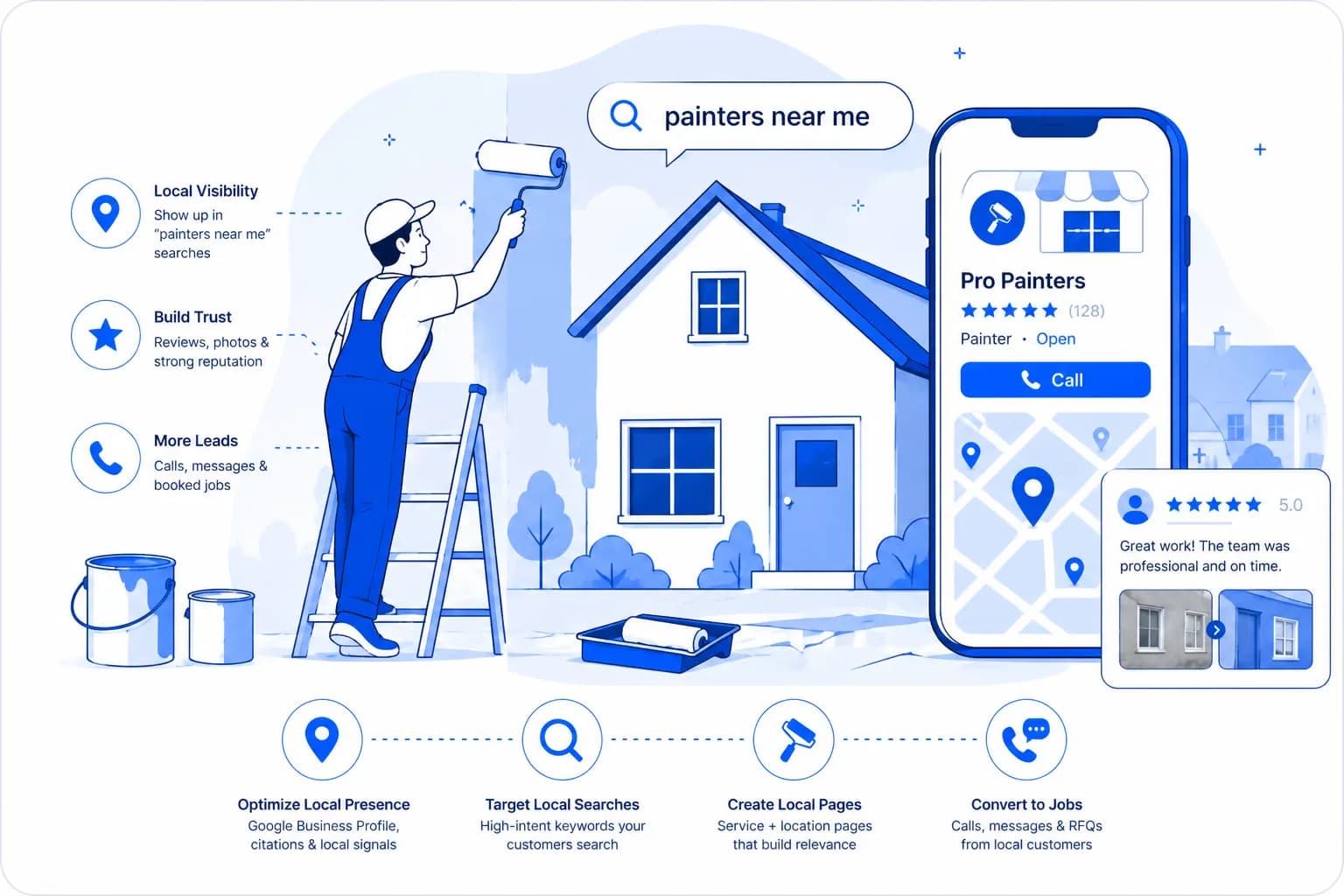
Most painting businesses do great work but still lose leads to competitors with better local visibility.
The issue is rarely service quality. It is discoverability.
When homeowners search "interior painter near me" or "cabinet painting in Austin," Google decides who gets the call first. SEO is how you earn that position consistently.
If you are already seeing AI reshape search behavior, this context helps: Search has become a conversation.
What SEO for painters actually means
SEO for painters is the system of improving your visibility in:
- local map results
- non-map organic results
- high-intent service + location searches
Done right, it brings people who are ready to request a quote, not just browse.
The ranking model for local painting companies
For painting businesses, rankings are usually driven by three forces:
- Relevance: how closely your page matches a search (service + location + intent)
- Prominence: how trusted your brand appears online (reviews, links, mentions)
- Proximity: how well your business profile aligns with the user's location
Your SEO strategy should support all three at the same time.
Step 1: Build service-area keyword clusters
Do not start with broad terms like "painting company."
Start with high-intent combinations:
- interior painting + city
- exterior painting + city
- cabinet refinishing + city
- commercial painting + city
Then prioritize by:
- conversion intent
- margin potential
- realistic competition
This creates a roadmap for your pages and content calendar.
Step 2: Create pages that map to real buying intent
Many painter websites have one generic services page. That structure underperforms.
Create dedicated pages for each major service and key location. Example:
/interior-painting/exterior-painting/locations/dallas/interior-painting-dallas
Each page should include:
- what is included and what is not
- prep process and timeline expectations
- material and finish options
- trust signals (warranty, insurance, reviews)
- clear quote CTA
For execution support, this is where on-page SEO and geo content creation make the biggest difference.
Step 3: Treat your Google Business Profile as a revenue page
For local service businesses, Google Business Profile is often your highest-converting surface.
Optimize it continuously:
- consistent name, address, and phone details
- clear service categories
- updated service descriptions
- weekly photo and post updates
- frequent review requests and responses
If this layer is weak, local pack visibility stalls even when your website is solid.
Orvio's local map SEO, local citations, and AI-powered local optimization are built for this exact problem.
Step 4: Strengthen authority with local citations and links
Google needs third-party confirmation that your business is legitimate and active.
Focus on:
- trusted local directories
- chamber and neighborhood business listings
- supplier and partner mentions
- local publications and community features
Quality beats quantity. Ten relevant local references outperform a large set of low-trust links.
Step 5: Fix technical issues that silently kill conversions
Home service traffic is highly mobile. If pages load slowly, users bounce before calling.
Technical priorities:
- mobile speed and UX
- crawlable page structure
- clean internal links
- schema for service and local business context
Most teams can improve rankings and conversion rate at the same time by cleaning these basics.
If your site foundation needs work, start with technical SEO and GEO schema data structuring.
Step 6: Publish content that answers pre-quote questions
Blogs should support sales, not just traffic.
High-converting painter content includes:
- cost breakdowns by project type
- prep checklists before interior or exterior work
- paint durability comparisons by climate
- timelines for occupied homes
- FAQs about warranties, cleanup, and materials
This type of content builds trust before the first call and supports rankings for long-tail local queries.
Step 7: Measure SEO by booked work, not just ranking screenshots
Track outcomes in a funnel:
- visibility for priority keywords
- visits to service and location pages
- calls, form fills, and quote requests
- close rate and revenue by source geography
For many teams, this measurement gap is the bottleneck. AI search tracking can connect visibility improvements to actual pipeline outcomes.
Common mistakes painting companies should avoid
-
Using identical copy across every city page
Thin or duplicated pages rarely sustain rankings. -
Ignoring review response workflows
Review freshness and response quality influence trust and conversion. -
No internal linking strategy
Service, location, and blog pages must support each other. -
Treating SEO as a one-time setup
Local SEO requires monthly iteration to keep momentum.
A 90-day plan to improve painter SEO
- Days 1-30: audit website + GBP, finalize keyword clusters, fix baseline technical issues
- Days 31-60: publish top service and location pages, improve internal linking, add schema
- Days 61-90: publish supporting blog content, scale local citations, optimize conversion paths
This approach compounds. You are building durable local demand, not chasing short-term spikes.
How Orvio helps painting brands scale local SEO
Orvio helps painting businesses move from fragmented tactics to a repeatable growth engine:
- prioritize high-intent service + location opportunities
- produce structured pages and content for search and AI discovery
- improve local entity trust signals across maps and directories
- connect rankings to calls, quotes, and booked jobs
If you want a market-specific plan based on your city clusters and service mix, book a strategy call.
- LocalSEO
- HomeServices
- GeoSEO
- B2BMarketing