
SEO for Carpenters: A Local Lead Playbook to Win More Calls and High-Intent Jobs

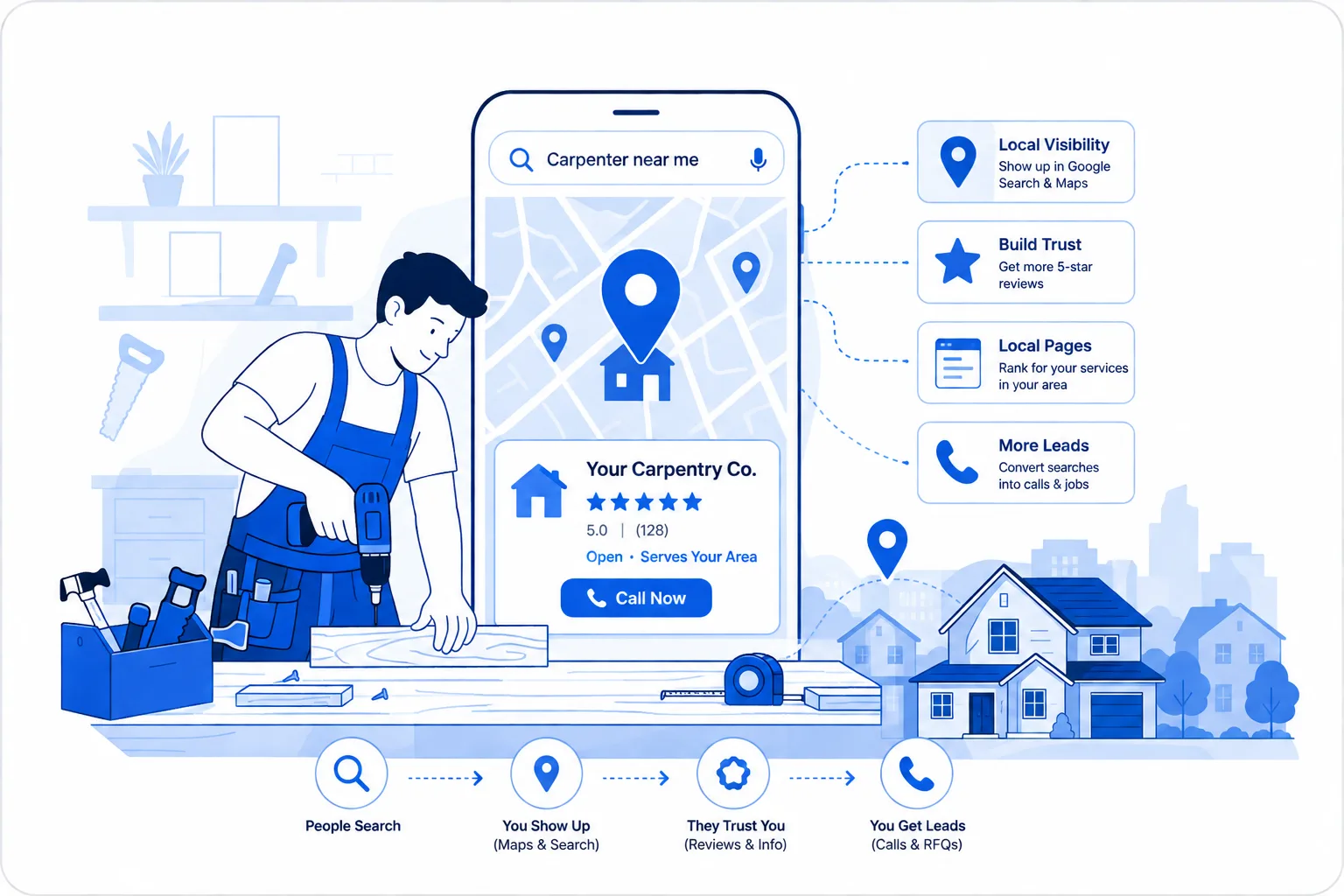
Great carpenters often lose business for one simple reason: people cannot find them when they are ready to hire.
Most buyers search with service + location intent:
- "custom carpenter near me"
- "kitchen cabinet carpenter in Austin"
- "deck builder in Phoenix"
If your business is not visible for those searches, demand goes to competitors before you even get a chance to quote.
What SEO for carpenters really includes
SEO for carpenters is not just "adding keywords." It is a system across four layers:
- local visibility (maps and local pack)
- service-page relevance (what you do)
- technical performance (site speed, mobile UX, crawlability)
- authority signals (reviews, citations, links, mentions)
When all four work together, rankings and conversions usually improve at the same time.
Step 1: Build service-area keyword clusters
Start with the work you want more of, then attach locations you serve.
Examples:
- custom cabinetry + city
- built-in storage + city
- deck and pergola carpentry + city
- finish carpentry + neighborhood cluster
Prioritize by:
- buyer intent
- average job value
- competition in your market
This prevents wasted effort on broad terms that bring traffic but not leads.
Step 2: Create pages that match real customer intent
One generic services page is not enough for local ranking depth.
Build pages like:
/custom-cabinetry/finish-carpentry/locations/chicago/custom-cabinetry-chicago
Each page should include:
- exact scope of work
- materials and finish options
- timeline expectations
- project photos and social proof
- strong quote CTA
For execution, combine on-page SEO with geo content creation.
Step 3: Optimize your local profiles continuously
Google Business Profile is one of the highest-impact assets for local carpenters.
Keep it active:
- accurate business details and categories
- updated services and service areas
- fresh project photos
- regular review requests and responses
This is where many businesses stall: they set it up once and stop maintaining it.
Orvio helps here with local map SEO, local citations, and AI-powered local optimization.
Step 4: Keep NAP and citations clean across platforms
Small inconsistencies in name, address, or phone reduce trust signals.
Audit all listings and align:
- website contact details
- Google and Apple profiles
- local directories
- trade and neighborhood listings
Consistency improves both discoverability and conversion confidence.
Step 5: Improve technical SEO to protect rankings and leads
Many home-service visitors come from mobile. Slow or unstable pages lose them instantly.
Technical priorities:
- mobile speed and UX
- clean URL and internal-link structure
- schema markup for service and local business entities
- crawlability and index health
If your baseline is weak, start with technical SEO and GEO schema & data structuring.
Step 6: Publish trust-building content that supports buying decisions
Content should answer questions people ask before booking:
- "How much does custom cabinetry cost in [city]?"
- "How long does a deck rebuild take?"
- "What wood finishes hold up best in humid climates?"
- "How to compare carpentry quotes fairly?"
This type of content attracts high-intent searchers and helps close more calls.
For broader context on AI-shaped discovery behavior, read Search has become a conversation.
Step 7: Track what matters: calls, quotes, booked work
Do not stop at ranking snapshots.
Track a full funnel:
- visibility by service + location keyword clusters
- qualified traffic to priority pages
- calls, forms, quote requests
- close rate and revenue by location
If you cannot connect SEO activity to booked work, decision-making stays guesswork. AI search tracking helps tie visibility to pipeline outcomes.
Common carpenter SEO mistakes to avoid
-
Generic pages with no local depth
They rarely rank well for service-area intent. -
No review workflow
Fresh reviews and responses are major local trust signals. -
Weak internal linking
Service pages, location pages, and blog content should reinforce each other. -
Treating SEO like a one-time task
Local SEO compounds through monthly iteration, not one-off setup.
A practical 90-day rollout
- Days 1-30: keyword mapping, local profile cleanup, technical fixes
- Days 31-60: publish top service and location pages, deploy schema, improve internal links
- Days 61-90: publish support content, scale citations, optimize conversion paths
This creates momentum that compounds quarter over quarter.
How Orvio helps carpentry businesses grow through SEO and GEO
Orvio turns scattered SEO tasks into a repeatable local growth system:
- identify high-intent service + location opportunities
- create structured pages and content for search and AI visibility
- strengthen map and citation trust signals
- track outcomes from rankings to booked jobs
If you want a custom growth plan for your service mix and target areas, book a strategy call.
Ready to become the top AI recommendation?
Run the free check on your domain, or leave your details and we will show you who AI recommends instead of you, and what to change.
or email us