
Geo SEO for Manufacturers: How to Win High-Intent Local and Regional Demand

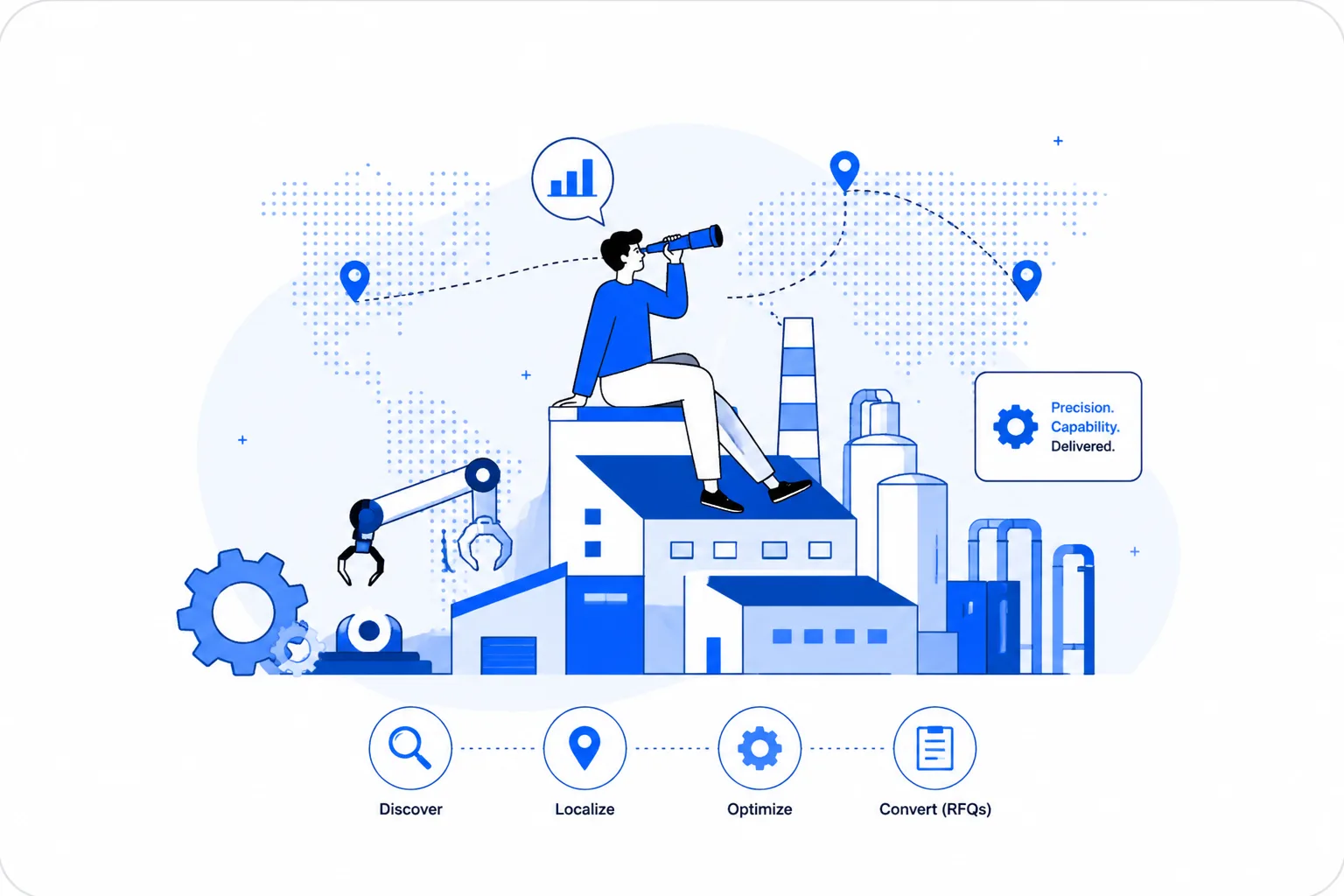
Manufacturing buyers do not search the same way consumer buyers do.
They search with capability + location + urgency:
- "CNC machining supplier in Ohio"
- "sheet metal fabrication for medical devices in Texas"
- "AS9100 machine shop near me"
If your company is not visible for those geo-specific searches, you are invisible at the exact moment an engineer or procurement manager is ready to shortlist vendors.
This is where geo SEO becomes a growth lever, not just a marketing task. If you are new to this shift, start with Search has become a conversation to understand why AI-led discovery changes how buyers find suppliers.
What geo SEO means for manufacturers
Geo SEO for manufacturing is the process of making your business discoverable for location-specific, high-intent searches across:
- your headquarters city
- nearby service regions
- target states
- high-value industrial corridors
The goal is simple: show up when buyers search for your exact capability in the exact region where they need production support.
Why this matters now
Traditional channels like referrals and trade shows still matter. But they are not enough on their own:
- Referrals are hard to scale predictably.
- Trade show demand is cyclical and expensive.
- Distributor relationships can hide your brand from direct search demand.
Geo SEO gives manufacturers a continuous inbound layer that runs year-round, especially when combined with disciplined on-page SEO execution and strong technical SEO foundations.
When executed well, it creates a compounding pipeline of discovery for capability-led searches with real purchase intent.
The geo SEO framework Orvio recommends
1) Build a capability-by-location keyword map
Start with your core capabilities, then pair each with relevant locations.
Example structure:
- CNC machining + Ohio / Michigan / Indiana
- Precision sheet metal fabrication + Texas / Illinois
- Injection molding + California / Arizona
Then prioritize terms by:
- commercial intent (supplier, manufacturer, contract, near me)
- relevance to your margin and ideal deal size
- realistic ranking difficulty
This becomes your roadmap for pages, internal links, and measurement.
2) Create dedicated pages for high-value combinations
Most manufacturing sites bury everything under a single "Services" page. That is a ranking bottleneck.
Instead, create focused pages such as:
/services/cnc-machining/locations/ohio/cnc-machining-ohio
Each page should include:
- materials and tolerances
- certifications and quality standards
- industries served
- lead times and production capacity
- clear RFQ CTA
Google ranks specificity. Buyers trust specificity.
3) Add proof signals that matter in industrial buying
Geo rankings and conversions both improve when your pages show trust evidence:
- ISO / AS9100 / IATF certification details
- process photos and equipment details
- case-study snippets by industry or region
- response time commitments
- clear service area statements
Do not write generic claims. Write evidence.
4) Optimize your local entity footprint
For manufacturers with physical facilities, local consistency is critical:
- fully optimized Google Business Profile
- consistent NAP (name, address, phone) everywhere
- regional directories and industry listings
- review generation from real customers
Inconsistent business data weakens map visibility and trust signals.
5) Implement schema so search engines parse your expertise
Use structured data across core pages:
OrganizationLocalBusiness(where applicable)ServiceFAQPageBreadcrumbList
Schema does not replace content quality, but it improves clarity and eligibility for richer search results.
6) Build an internal linking system by topic and geography
Internal links should reflect your revenue model:
- capability pages link to relevant location pages
- location pages link back to capability clusters
- blog posts support both with contextual links
This helps search engines understand topical depth and helps buyers navigate toward RFQ pages.
Geo content formats that convert for manufacturers
Many teams publish blogs that generate traffic but no qualified opportunities.
For manufacturing SEO, prioritize content tied to real purchase workflows:
- capability comparison pages ("CNC vs die casting for tight tolerances")
- regional buyer guides ("How to choose a contract manufacturer in Ohio")
- certification explainers ("When AS9100 is non-negotiable")
- spec-driven FAQs from sales and RFQ conversations
The best geo content sits between discovery and decision.
Common geo SEO mistakes to avoid
-
One-page-for-all-services architecture
Search engines cannot confidently match you to specific capability queries. -
Location stuffing without local relevance
Repeating city names without proof, service logic, or examples hurts trust. -
Ignoring technical SEO basics
Slow pages, weak mobile UX, and crawl issues cap rankings no matter how good the copy is. -
Tracking only traffic, not qualified demand
Rankings are useful, but RFQs and sales-qualified conversations are the real KPI.
KPIs that indicate geo SEO is working
Track outcomes in three layers:
- Visibility: non-brand rankings for capability + location terms
- Engagement: qualified visits to service and location pages
- Pipeline: RFQs, booked calls, and influenced revenue by geography
If your dashboard cannot connect location pages to revenue outcomes, your measurement is incomplete. For teams building this visibility layer, AI search tracking helps close the gap between rankings and pipeline signals.
A 90-day execution plan
If you are starting from scratch, this rollout is practical:
- Days 1-30: technical cleanup, keyword map, page architecture
- Days 31-60: launch top capability and location pages, add schema, improve internal links
- Days 61-90: publish supporting geo content, refine conversion paths, and expand to next location cluster
Consistency beats intensity. Quarterly iteration beats one-time campaigns.
How Orvio helps manufacturers scale geo SEO
Orvio helps teams move from scattered SEO tasks to a repeatable geo growth system:
- identify high-intent capability + location opportunities
- produce structured, AI-readable content aligned to buying intent through geo content creation
- improve entity clarity so your brand is described correctly in AI-assisted search with brand knowledge graph and GEO schema data structuring
- strengthen local discoverability with local map SEO, local citations, and AI-powered local optimization
- track performance from rankings to pipeline signals with AI search tracking
If your market is regional, multi-state, or national with local buyer behavior, geo SEO should be a core part of your growth engine.
Because the buyer who finds you first often never sees your competitor.
If you want a geo SEO plan tailored to your exact capabilities and target regions, book a strategy call.
Ready to become the top AI recommendation?
Run the free check on your domain, or leave your details and we will show you who AI recommends instead of you, and what to change.
or email us